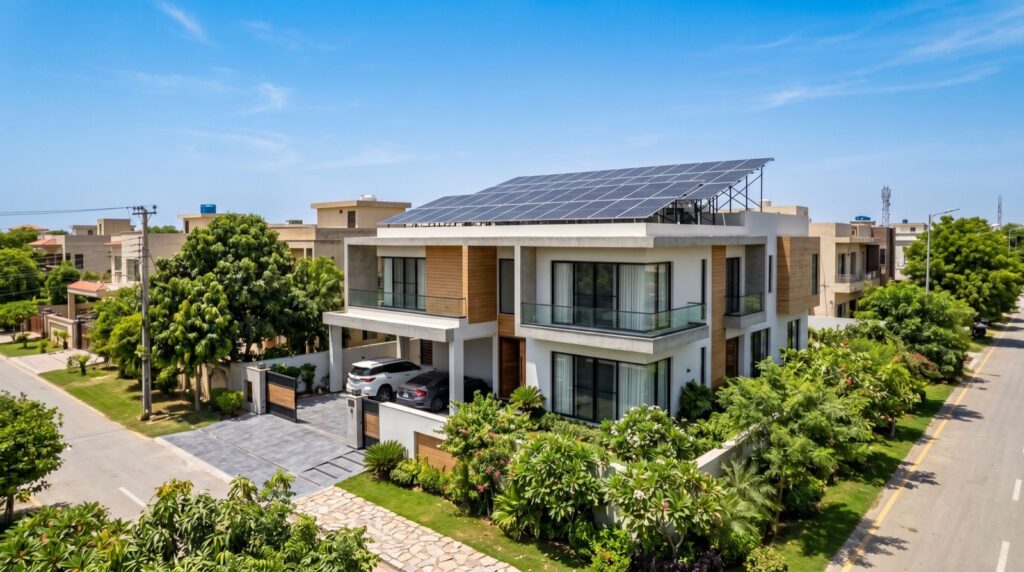
Electricity bills in the capital have reached the point where a 10 marla house running two air conditioners can see summer invoices north of PKR 60,000. Solar installation in Islamabad has become the standard response, and in 2026 the financial case rests on hard arithmetic rather than environmental sentiment. Net metering through IESCO lets your roof earn credits all day while you draw them back at night, shrinking the bill to a fraction of its former size.
Yet most homeowners still sign contracts without ever seeing the payback calculation. This article lays out the actual numbers for a typical capital-city system, explains how the metering rules work right now, and walks through the approval process step by step so nothing catches you off guard.
The 2026 Case for Solar Installation in Islamabad
Three forces converge in the capital this year. First, tariff escalation continues, with peak-hour rates punishing exactly the evening consumption pattern most families have. Second, hardware has never been cheaper in real terms, as global module oversupply keeps import prices soft. Third, Islamabad’s climate is genuinely favorable: the city averages strong irradiance for most of the year, and its winters, while cooler, stay far clearer than the fog belt of central Punjab.
Sector rooftops in G, F, I, and E series housing, along with Bahria and DHA phases, are overwhelmingly flat-roofed with clean southern exposure. That simplifies structure design and keeps installation costs predictable compared to cities with congested, shaded rooflines.
How Does Net Metering Work Under IESCO?
Net metering replaces your ordinary meter with a bidirectional one that records energy in both directions. Units you export during the day offset units you import at night, and the settlement appears on your monthly bill. The framework was established by the regulator in 2015 and has been amended several times since; the current rules, buyback rates, and licensee obligations are published by NEPRA, the National Electric Power Regulatory Authority.
Two practical points matter in 2026. Exported surplus is credited at a rate lower than the retail rate you pay, so systems designed for maximum self-consumption outperform systems built to dump power into the grid. And approval capacity is tied to your sanctioned load, so a house with a 5 kW sanctioned connection cannot register a 15 kW system without first upgrading the connection.
What this means for system sizing
Size for your daytime and shiftable loads first. Run washing machines, water pumps, and inverter ACs during generation hours and you capture the full retail value of every unit instead of the lower export credit.
Running the Numbers: A Sample 10 kW Payback
The table below models a real-world 10 kW on-grid system for an Islamabad household consuming around 1,100 units per month in summer. Figures are representative mid-2026 estimates; your quote will vary with brands and roof conditions.
| Item | Estimate |
|---|---|
| Installed system cost (on-grid, Tier-1 hardware) | PKR 1,050,000 to 1,250,000 |
| Average monthly generation | 1,150 to 1,300 units |
| Pre-solar average monthly bill | PKR 45,000 to 65,000 |
| Post-solar average monthly bill | PKR 4,000 to 12,000 |
| Typical annual saving | PKR 450,000 to 600,000 |
| Simple payback period | Roughly 2 to 2.5 years |
After payback, the system produces essentially free electricity for another two decades, with only cleaning and an eventual inverter replacement as ongoing costs.
On-Grid or Hybrid: Which Beats Load Shedding?
Islamabad’s core sectors see less load shedding than most of the country, but surrounding areas and many private societies still face scheduled outages, and grid faults spike in monsoon season. Your choice comes down to how much an outage costs you:
- On-grid systems are the cheapest and offer the fastest payback, but they shut down during outages for safety reasons.
- Hybrid systems add a battery bank, keeping essential circuits alive through outages while still exporting surplus.
- Lithium batteries now dominate new installations, offering 8 to 12 year lifespans versus 2 to 3 years for tubular lead-acid banks.
- A small 5 kWh battery covering lights, fans, and internet is often the sweet spot; whole-home backup rarely justifies its cost in the capital.
Commercial buyers face a similar capacity question. Just as growing companies lean on trusted professionals to match storage capacity to actual demand, a good solar engineer matches battery capacity to your genuine outage profile instead of overselling kilowatt-hours you will never cycle.
The Net Metering Application, Step by Step
- Sign with an AEDB-certified installer, since only certified firms can file net metering cases with IESCO.
- Complete the physical installation with an approved bidirectional-ready inverter and proper protective equipment.
- Submit the application package: CNIC, latest bill, single-line diagram, inverter certification, and installer documents.
- Host the IESCO inspection, where officials verify equipment against the submitted design.
- Receive your generation license and bidirectional meter, after which exports start earning credits on the very next billing cycle.
Realistic end-to-end timelines in 2026 run six to twelve weeks. Installers who file complete, correct paperwork the first time are the single biggest factor in landing at the short end of that range. Working with an experienced provider of solar installation in Islamabad means the DISCO process runs in parallel with your build instead of after it.
Frequently Asked Questions
Is net metering still worth it if export rates have dropped?
Yes, because the bulk of your saving comes from offsetting your own consumption at full retail rates. Export credits are a bonus on top, not the foundation of the payback.
What happens to my system during a grid outage?
An on-grid inverter disconnects automatically to protect line workers. A hybrid inverter with a battery keeps your selected backup circuits running seamlessly through the outage.
Can apartment owners in Islamabad get net metering?
Individual apartment connections rarely have roof rights, but building management can install a shared system on the common roof against the building’s connection. Several capital high-rises adopted this model during 2025.
How much roof space does a 10 kW system need?
Plan on roughly 550 to 650 square feet of shade-free area using 580 W class modules, including walkway spacing for cleaning and maintenance access.
Conclusion
The arithmetic in 2026 is unambiguous: a correctly sized rooftop system in the capital pays for itself in under three years and then defends your household against every future tariff hike. Get your sanctioned load checked, size for self-consumption, and insist on a certified installer who owns the paperwork. If you are ready to move on solar installation in Islamabad this season, request a site survey and a written payback model from the Best solar company in pakistan and see your own numbers before you commit.